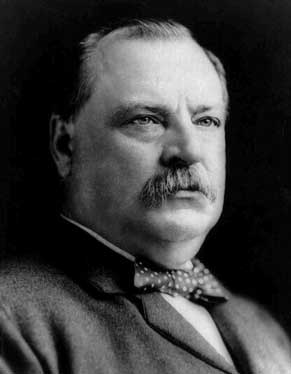
The only president to serve two non-consecutive terms, Cleveland was a champion of honest government who fought high tariffs and patronage. His second term was consumed by the brutal depression that followed the Panic of 1893. Elected 1884 →
Born
Mar 18, 1837Caldwell, NJ
Died
June 24, 1908Princeton, NJ
Party
Democratic
Vice President
T. A. Hendricks · Adlai Stevenson
First Lady
FrancesCleveland
War
None
Grover Cleveland
Cleveland is the only President to serve two non-consecutive terms. His first term is best known for continued reform of civil service, and the passing of the Interstate Commerce Act. He lost re-election over the tariff issue.. Elected 1884 Elected 1892
Watch — Grover Cleveland in brief
Cleveland was born in Caldwell, New Jersey. When he was four, his family moved to Fayetteville, New York, and when Grover was 14, to Clinton, New York. Cleveland went to high school at the Clinton Liberal Institute and the Fayetville Academy. He hoped to go on to college, but his father's death forced him to go to work instead.
In 1855 he decided to settle in Buffalo where he had an uncle who hired him to edit the "American Shorthorn Handbook". His uncle also arranged for him to study law at a local law office. He was admitted to the bar in 1859.
From 1859 to 1863 and from 1865-1871 Cleveland practiced law in Buffalo and became active in the Democratic party. He did not serve in the Civil War, choosing instead to pay a substitute. From 1863-65, Cleveland served as the Assistant District Attorney for Erie County.
From 1871-73, Cleveland served as the Sheriff of Erie County. He established a reputation for competence and incorruptibility. After his term, he returned to his law practice, which he pursued until 1882 when he was elected as the Mayor of Buffalo. He served only one year as mayor and again established a reputation for honesty and competence. Within a year, he was elected Governor of New York. As Governor, he continued to maintain his reputation for competence. His public slogan became "Public Office is a Public Trust."
Accomplishments in Office
Cleveland's first term in the White House was uneventful. He built on his reputation for competence by expanding the civil service reform begun by his immediate predecessors. He was known to be a severe auditor of private pension and relief bills, vetoing many of them.
Cleveland was a strong supporter of the Interstate Commerce Act that gave the federal government the power to regulate railroads. Cleveland's most controversial action was his support for the reduction of tariffs, which he felt was causing an unneeded government surplus.
The high point in his Presidency was his wedding, on July 2, 1886, to the 21 year-old Frances Folsom, in the White House. It was the first White House wedding.
From the makers of HistoryCentral
Explore our history apps
Take HistoryCentral with you. Our apps put American history and centuries of the human story in your pocket.