 >
>Battle of Yorktown 1781
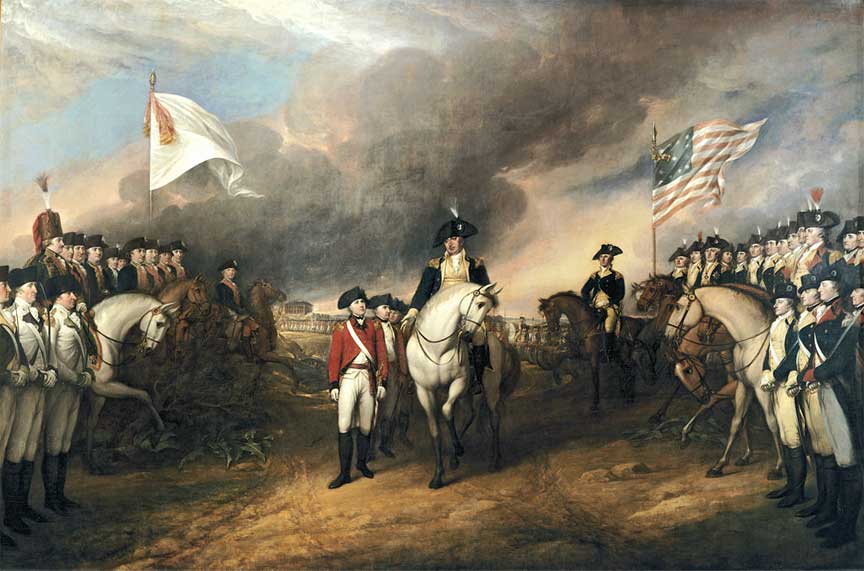
General Cornwalis arrived in Petersburg in May of 1781He then went to , Yorktown and began preparing a naval base there. General Washington moved south and, together with French ground and naval forces, surrounded the British army, forcing its surrender. This victory by Washington and French forces ended the war.
The summer into fall of 1781 was to become the decisive moment in the Revolutionary War. The British Southern campaign plan was in tatters after the successive victories, and near victories by American forces in the South. The British were now confined to coastal towns. Meanwhile, the French reinforcements the Americans had been promised had finally arrived in Rhode Island. The initial plan had been for the French to the combine with the American forces, and together they would retake New York. The Americans and their allies also enjoyed a unique advantage. For the first time in the war, French Naval forces in the Western Atlantic were superior to the British troops. France had been engaged in a decade-long effort to grow its Navy. Their efforts reached fruition in 1781, while the British Navy, which remained as formidable as ever was stretched around the world, in a global fight for naval superiority.
On July 8, 1781, the French army completed an 18 day march from Rhode Island and arrived near White Plains, New York to join the US Army there. The two combined armies then headed South toward New York City. The French and Americans found the defenses of New York formidable. In the meantime, they learned that Cornwallis was retreating with his army toward the Chesapeake Bay and Yorktown. General Washington concluded that using his forces to surround Cornwallis' Southern army would be the most decisive use of his forces. Washington and the French commander, General Rochambeau, were spurred to action when they learned that French Admiral De Grasse had sailed from Haiti with 29 ships of the line; 4 frigates and an additional 3,000 men. This fleet, combined with the smaller squadron of Barras in Rhode Island, would give the French a decisive advantage over the British navy. DeGrasse and his forces were headed for Virginia. They would rendezvous with the Continental forces led by General Greene and Marquis Lafayette, who had come South. Together their forces had stopped Cornwalis’ army from creating havoc in Virginia and forcing his forces toward the coast.
With the knowledge that the French fleet was heading toward Virginia, Washington spurred his forces Southward, in what he hoped might become a decisive victory. On August 19th, Washington's armies headed out. They headed out, first to the North, to cross the Hudson, as well as to confuse the British as to their destination. It took Washington's armies until September 2nd to reach Philadelphia, the American capital. The American army, followed by the French army, paraded through the capital, accompanied by the appropriate pomp and ceremony.
While the American army was marching South, the most decisive naval battle of the war, (and possibly of the century), took place off the Virginia Capes. A British squadron, under the command of Admiral Hood, took on the larger French fleet, under De Grasse, who had come out to meet the British force. The battle was a classic naval battle, in which the larger sized French fleet slowly took its toll on the smaller British fleet. The British and the French lost an equal number of men and had an equal number of ships damaged. However, as hours went by, the British fleet was dwindling fast, and De Grasse's troops were reinforced with the arrival of additional French ships under the command of Barras. In the end, the British were forced to withdraw, after sustaining over 300 naval casualties. Their withdrawal would doom Cornwallis, who remained in Yorktown, despite the imminent arrival of the large American and French armies.
On September 14th, Washington arrived in Williamsburg, NY. On September 20th, the siege of Yorktown began. For the first time in the war, the Americans held overwhelming superiority in every way. Together, the Americans and the French fielded an army of 19,000 soldiers, all but 3,000 of whom were regulars. The British had only 9,000. The Allied forces outgunned the British and were well supplied. Finally, the Allied forces controlled the sea.
Washington and Rochambeau decided that the way to conquer Yorktown was through a classic siege. Cornwallis made their efforts a little easier by consolidating his lines. On October 5th, the Americans began building their first siege trench, under French direction. By October 9th, the trench had progressed far enough that cannons could be placed. Then, American and French forces began their bombardment of the British in Yorktown. 3,500 rounds were fired into the city every day. To extend the lines, the Americans and the British had to take two British outposts, known as outpost #9 and #10.
On the evening of October 14th, an American force, led by Alexander Hamilton, captured outpost #10, and French forces captured outpost #9. These captures allowed the allies to extend their lines. The next night the British made a useless attempt to counterattack. Then, long after the net had closed, Cornwallis tried to get his men out of Yorktown. That attempt failed.
The next day, October 17th began with a massive bombardment by American and British forces. At 10:00 AM, a white flag went up over the British lines. The Allied guns went silent. A British officer, accompanied by a drummer, emerged from the British lines. He was escorted to Washington's headquarters, where he gave Washington a letter proposing a ceasefire and surrender negotiations.
Washington demanded to know what terms Cornwallis was proposing. The British officer returned to his lines, but quickly responded with terms the Americans and French believed could be the basis of negotiations. The next day, negotiators for the British and Americans met all day to negotiate terms. The terms were reached by the next night. The British army would surrender; one officer in every 50 was to be paroled, and one ship would be allowed to sail to New York, with deserters, or whomever Cornwallis wanted to send.
The next day, on October 19th, at 2 o'clock in the afternoon, the surrender ceremony began. The British soldiers marched between two long lines of Allied soldiers to surrender. The Americans captured 8,000 soldiers, 214 pieces of field artillery, and thousands of muskets. Washington penned a short letter to the Congress: "A reduction of the British army under the command of Lord Cornwallis is most happily effected. The war was effectively over. The Americans had won!!
General Washington's Report-Head Quarters Before York, October 16, 1781 SIR: I had the honor to inform your Excellency in my last, of the l2th. instant, that we had the evening before opened our second parallel. The 13th. and 14th. we were employed in compleating it. The Engineers having deemed the two Redoubts on the left of the enemy's line sufficiently injured by our shot and shells to make them practicable,- More From GW |
Journal of Colonel Jonathan Trumbull, Secretary to George Washington. [September] 28. A most wonderful and very observable coincidence of favorable circumstances having concentered our various and extended preparations, the army commences its march from Williamsburg and approaches within two miles of Yorktown- Journal Entry |