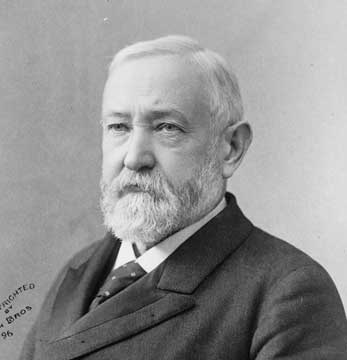
In office March 4, 1889 — March 4, 1893 · Republican
Grandson of William Henry Harrison, Benjamin Harrison presided over an activist Congress that passed the Sherman Antitrust Act and admitted six new states. He lost his bid for re-election to the man he had beaten, Grover Cleveland. Elected 1888 →
Born
Aug 20, 1833North Bend, OH
Died
Mar 13, 1901Indianapolis, IN
Party
Republican
Vice President
Levi P. Morton
First Lady
CarolineHarrison
War
None
Benjamin Harrison
Benjamin Harrison's Administration was notable for its lack of action. Corruption ran rampant during his tenure, and the federal budget surpassed $1 billion for the first time. Elected 1888
Watch — Benjamin Harrison in brief
Benjamin Harrison was born at the home of his grandfather, William Henry Harrison, in North Bend, Ohio. Harrison grew up on a farm called The Point, given to his father by his grandfather when the elder man was elected President. Harrison was tutored both at home and in a one-room schoolhouse nearby. Between 1847 and 1850, Harrison attended Farmers' College, a preparatory school in Cincinnati. In 1850, he was admitted as a junior to Miami University in Oxford, Ohio, from which he graduated in 1852. From 1852-1854 he studied law.
From 1854 until the Civil War, he practiced law in Indianapolis. In 1857, Harrison was elected Attorney of the City of Indianapolis. He joined the Republican party and was a strong supporter of Lincoln. In 1862, he joined the Union Army as a Second Lieutenant. During the war, he rose to the rank of Brigadier General.
From the end of the war until 1881, Harrison maintained his law practice, while continuing to be active in the Republican party. He ran unsuccessfully for governor. In 1881, Harrison was elected by the Indiana legislature to serve in the Senate. He served for six years. During this time he was a strong supporter of pensions for Civil War veterans. He was a strong supporter of tariffs. Harrison was untainted by any scandals, and this sufficed to make him a good candidate for the Republicans.
Accomplishments in Office
Harrison's term as President was remarkably unexceptional, mirroring the calm and unassuming nature of the President himself. Faced with numerous requests for political appointments by Republicans who had been out of power for four years, Harrison, in his tranquil manner, attempted to resist. However, he could not turn down all the requests. His unsuccessful attempt to extend the Civil Service and the passing of the Sherman Anti- Trust Act by the Congress, the first law to curb the abuses of monopolies, further reflect the unassuming nature of his presidency.
Harrison supported the McKinley Tariff Act of 1890. This act was extremely protectionist. It set the average tariff at 48 percent. Because of the tariffs, the government was building a large surplus. Harrison did his best to spend that surplus on infrastructure projects and an expanded Navy. For the first time in peacetime, the Federal government's budget passed 1 billion dollars. During Harrison's term, the last major battle with the Indians took place- at Wounded Knee.
Harrison was active in foreign affairs. He helped convene the first Pan-American Congress, which established the Pan-American League.
From the makers of HistoryCentral
Explore our history apps
Take HistoryCentral with you. Our apps put American history and centuries of the human story in your pocket.