DC-3 Introduced
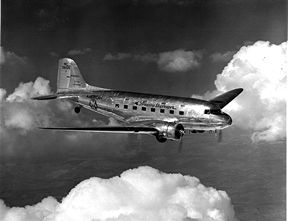
On December 17, 1935 — the thirty-second anniversary of the Wright Brothers' first flight at Kitty Hawk — a new aircraft rolled down the runway at Clover Field in Santa Monica, California, and lifted off into aviation history. The Douglas Sleeper Transport (DST) made its first flight that day, the product of a marathon telephone call in which C. R. Smith, president of American Airlines, had persuaded a reluctant Donald Douglas to design a larger, more comfortable plane that could lure the luxury trade.
National Air and Space Museum The original DST was configured as a sleeper with fourteen berths for overnight transcontinental flights, but it was the day-plane version — known as the DC-3, with twenty-one seats instead of fourteen berths National Air and Space Museum — that changed the world. The DC-3 was an all-metal, low-wing, twin-engine monoplane with retractable landing gear, a cruising speed of around 190 mph, and a range of 1,500 miles.
It could cross the continental United States from New York to Los Angeles in eighteen hours with only three fuel stops. It was comfortable by the standards of its day — soundproofed, insulated, with large windows and hot meals served aloft — and it was extraordinarily safe, thanks to its strong multiple-spar wing and excellent single-engine performance. American Airlines inaugurated DC-3 service between New York and Chicago on June 25, 1936.
Within a year, Smith declared: "It was the first airplane in the world that could make money just by hauling passengers." National Air and Space Museum That single sentence announced a revolution: for the first time in the history of aviation, an airliner could turn a profit carrying passengers alone, without depending on government mail subsidies to stay solvent. By 1939, at the peak of its dominance, approximately 90% of all airline flights on the planet were operated by a DC-3 or one of its variants.
Wikipedia The outbreak of World War II transformed the DC-3 from a commercial airliner into one of the most important military aircraft of the conflict. Redesignated the C-47 Skytrain by the U.S. Army Air Forces (and the Dakota by the Royal Air Force), the militarized DC-3 hauled paratroopers into Normandy on D-Day, towed gliders over the Rhine, supplied the Burma campaign over the Hump, and flew countless missions in every theater of the war.
General Dwight D. Eisenhower later listed the C-47, along with the jeep, the bazooka, and the atomic bomb, as one of the four weapons that most contributed to Allied victory. In total, 803 commercial transports and 10,123 military versions were built by Douglas, with an additional 3,000 constructed under license in Russia as the Lisunov Li-2 and almost 500 in Japan National Air and Space Museum — bringing total worldwide production to more than 13,000 aircraft.
After the war, thousands of surplus C-47s were converted back to civilian use and sold at bargain prices, flooding the market with cheap, reliable transports that enabled airlines around the world — from South America to Southeast Asia to postwar Europe — to launch or expand their operations. The DC-3 became the backbone of the global air transport system in the late 1940s and 1950s, and its rugged construction, ease of maintenance, and ability to operate from short, unpaved runways kept it flying in remote corners of the world for decades afterward.
Perhaps unique among prewar aircraft, the DC-3 continues to fly in active commercial and military service as of 2025, ninety years after its first flight, Wikipedia with over a hundred still airworthy worldwide. As pilots have long said: "The only replacement for a DC-3 is another DC-3."