Doolittle Seizes the Speed Record
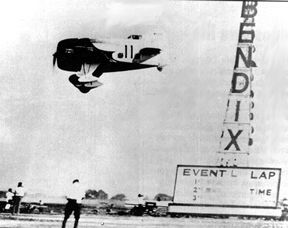
On September 3, 1932, at the Cleveland National Air Races — the most spectacular aviation event in Depression-era America — Major James H. "Jimmy" Doolittle climbed into the cockpit of one of the most terrifying aircraft ever built: the Granville Brothers Gee Bee R-1 Super Sportster, a snub-nosed, barrel-shaped racing monoplane that pilots had nicknamed "the Flying Silo." Powered by an 800-horsepower Pratt & Whitney Wasp engine, the fuselage was streamlined from the engine cowling, tapering to a knife-like rudder, just in front of which the pilot sat — so far aft that the cockpit was virtually on top of the tail.
The Gee Bee had already earned a reputation as a killer: its tiny wings, minuscule control surfaces, and forward center of gravity made it viciously unstable, and a number of pilots had died trying to fly it. But Doolittle — a former Army test pilot with a doctorate in aeronautical engineering from MIT — was not most pilots. That afternoon, he shattered the world landplane speed record by averaging 296.287 miles per hour over a three-kilometer course, besting the eight-year mark held by France's Warrant Officer Bonnet by nearly 18 miles per hour.
On one of his six passes he reached 309 mph — the fastest any human being had ever traveled in a propeller-driven aircraft at the time. Later that same day, before 60,000 spectators, he won the prestigious Thompson Trophy Race, the main event of the air races, completing the 10-lap, 100-mile closed-course race at an average speed of 252.7 mph — a Thompson Trophy record that would not be surpassed for four years. After the race, Doolittle praised the aircraft with characteristic understatement: "She is the sweetest ship I've ever flown." Jimmy's victory was the high point of the Granville Brothers' racing saga.
Although plans were being made to modify the R-1 and R-2 for even more speed and greater fame, Doolittle had had enough. Figuring he had used up all his luck, he never raced again. His instinct proved sound: the Gee Bee R-1 was destroyed the following year when pilot Russell Boardman was killed in a takeoff crash at Indianapolis, and virtually every other pilot who flew the various Gee Bee models also met violent ends. But for Doolittle, the Thompson Trophy was merely one chapter in what became one of the most extraordinary careers in American history.
He was a highly educated military officer, having earned a Bachelor of Arts from the University of California Berkeley and both M.S. and D.Sc. degrees in aeronautical engineering from the Massachusetts Institute of Technology — at a time when most pilots were barnstormers who had never set foot in a college classroom. In 1929, he had made the first-ever "blind" flight, taking off, flying, and landing an airplane entirely by instruments — a breakthrough that made modern commercial aviation possible.
A decade after his Thompson Trophy triumph, on April 18, 1942, then-Lieutenant Colonel Doolittle planned and led the famous Doolittle Raid, in which sixteen B-25 Mitchell bombers launched from the aircraft carrier USS *Hornet* to strike Tokyo — the first American attack on the Japanese home islands, a daring blow that electrified a nation still reeling from Pearl Harbor and for which he was awarded the Medal of Honor. He went on to command the Twelfth Air Force in North Africa, the Fifteenth Air Force in the Mediterranean, and the mighty Eighth Air Force in England, directing the strategic bombing campaign against Germany.
After the war he was promoted by special Act of Congress to four-star general — the only person in American history to hold both the Medal of Honor and the Medal of Freedom. General James Harold Doolittle died on September 27, 1993, at the age of 96, and was buried at Arlington National Cemetery. The barrel-shaped Gee Bee that had nearly killed him sixty-one years earlier was, in the end, just the opening act.