Pan Am Begins Service to Manila
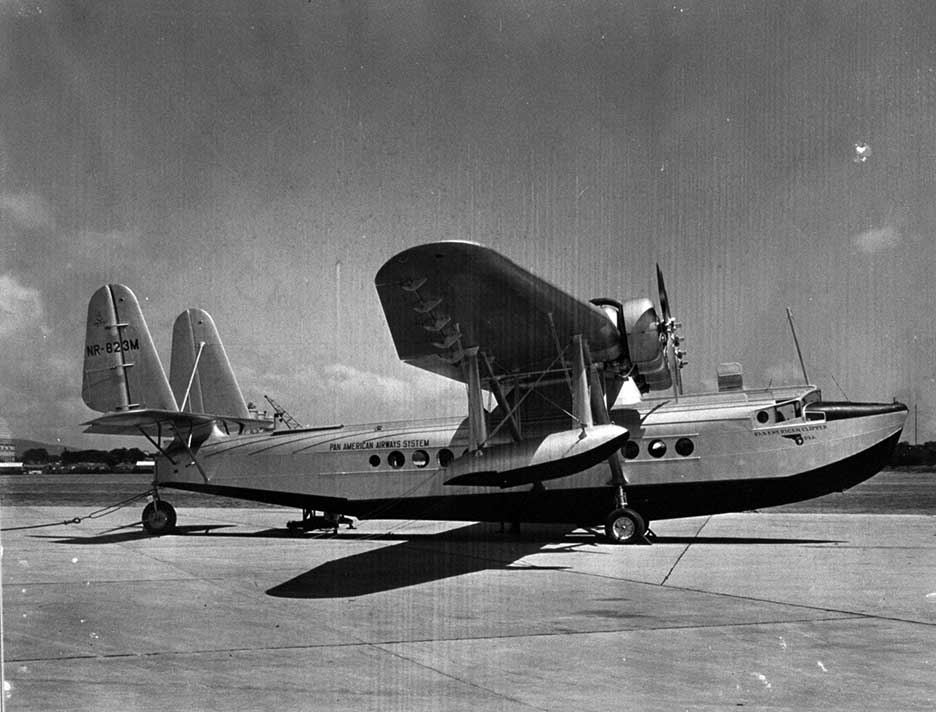
On the afternoon of November 22, 1935, with a great ceremony broadcast nationally over the radio, Pan American Airways' China Clipper — a gleaming Martin M-130 four-engine flying boat, registration NC14716 — lifted off from the waters at Alameda, California, in San Francisco Bay, bound for Manila in the Philippine Islands, 8,000 miles away across the Pacific Ocean. Pan Am president Juan Trippe's voice came over the radio: "Captain Musick, you have your sailing orders." At the controls was Captain Edwin C.
Musick, Pan Am's legendary chief pilot, with First Officer R.O.D. Sullivan and a crew that included navigator Frederick Noonan — who would later accompany Amelia Earhart on her fatal around-the-world attempt. The payload consisted of over 110,000 pieces of airmail weighing approximately 2,000 pounds, making it the largest mail shipment ever taken on board an airplane. There were no passengers on this inaugural flight — only mail and crew.
The flight plan called for the China Clipper to fly over the still-unfinished San Francisco-Oakland Bay Bridge on takeoff as a dramatic gesture, but upon takeoff the pilot realized the plane would not clear the structure and was forced to fly narrowly under it instead — a heart-stopping moment witnessed by thousands of spectators lining the Bay. The Clipper then headed west into the setting sun, hopping across the Pacific via Honolulu, Midway Island, Wake Island, and Guam — each stop on an "all-American" flag route where Pan Am had spent months constructing airstrips, fuel depots, weather stations, and even prefabricated hotels, ferrying all the supplies across the ocean on a chartered freighter.
The China Clipper arrived in Manila on November 29, 1935. Not counting the layover time spent at the several ports along the route, the actual flying time was 59 hours and 48 minutes. The same voyage by the speediest steamship would have taken 15 to 16 days. The Martin M-130 that made this historic crossing was one of the most impressive aircraft of its era — 90 feet 10 inches long, with a wingspan of 130 feet, powered by four Pratt & Whitney Twin Wasp 14-cylinder radial engines, and weighing over 52,000 pounds fully loaded.
Built at a cost of $417,000 by the Glenn L. Martin Company in Baltimore, Maryland, the M-130 could carry 18 passengers on overnight flights or up to 36 on daytime hops, with a range of 3,200 miles — enough to cross any of the vast oceanic legs without refueling. Pan Am crews affectionately called her "Sweet Sixteen," a reference to the last digits of her registration number, NC14716. To depression-weary Americans, the new Martin Clipper possessed magical qualities.
She conjured up visions of the exotic East, of faraway places and mysterious lands. She was a fantasy craft, a magic carpet built and flown by Americans, destined for adventure. By October 1936, the route was ready for paying passengers, and Pan Am began regular passenger service across the Pacific — reducing a journey that had taken weeks by steamship to less than six days by air. A five-day journey from the US West Coast to East Asia was a massive breakthrough that shrank the Pacific from a barrier into a bridge.
Pan Am eventually built two sister ships — the Philippine Clipper and the Hawaii Clipper — but none of the three M-130s survived. The Hawaii Clipper vanished without a trace between Guam and Manila in July 1938; the Philippine Clipper crashed into a mountain in northern California in January 1943, killing all aboard including a Navy admiral; and the original China Clipper herself broke apart during a night landing at Trinidad in January 1945, ending the brief, glamorous life of the flying boat that had opened the Pacific to commercial aviation.
Humphrey Bogart had starred in a 1936 Warner Brothers film titled *China Clipper*, and the name became synonymous with an entire era of ocean-spanning flight — a time when crossing the world's largest ocean in a flying boat with four thundering radial engines, touching down on the lagoons of coral atolls whose names most Americans had never heard, was the most romantic adventure in all of aviation.